
Making sense of menopause, together.
- Connect with women who get it
- Get expert-reviewed resources
- Learn from real women's experiences
Powered By


 2 Reactions
·
Save
2 Reactions
·
Save
Finding out you have an ovarian cyst after menopause can be confusing. After all, you’re no longer ovulating, so you might wonder why a cyst would form. While many ovarian cysts are related to a woman’s menstrual cycle, some can develop for other reasons.
In this article, you’ll learn what ovarian cysts are, why they can happen after menopause, what symptoms they may cause, and how doctors diagnose and treat them. If you’re having new or persistent pelvic pain, schedule an appointment with your healthcare provider.
Ovarian cysts are sacs that form on or inside the ovaries. They can be filled with fluid, solid tissue, or a mix of both.
Ovarian cysts can vary in size. Some are very small, while others can grow several centimeters wide. For comparison, an average ovary is about 4 centimeters wide.
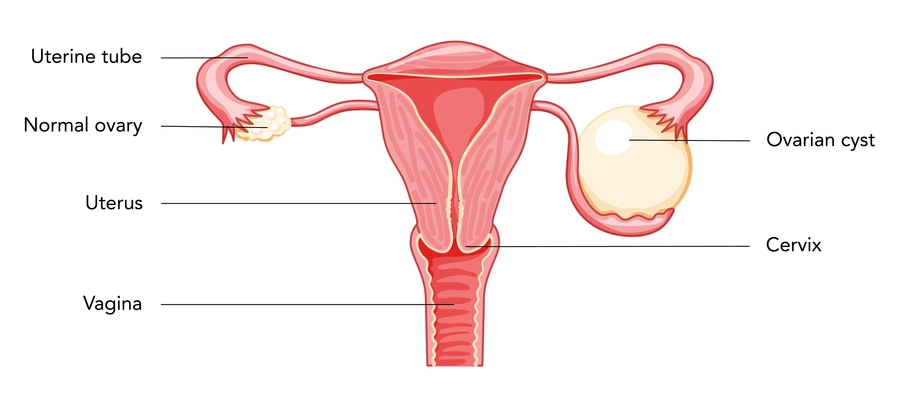
Ovarian cysts are fairly common. About 1 in 10 women will have at least one during their lifetime.
There are several types of ovarian cysts, and most are harmless. Although ovarian cancer is possible, most ovarian cysts are not cancerous, especially simple cysts.
Ovarian cysts can develop for several reasons. Before menopause, the most common cause is ovulation, when the ovary releases an egg as part of the menstrual cycle.
After menopause, when ovulation has stopped, ovarian cysts are more often linked to abnormal cell growth or other changes that aren’t related to ovulation. Because of this, cysts found after menopause are usually evaluated more carefully.
Ovarian cysts after menopause can be more concerning because they are more likely to be cancerous than cysts that develop in women who are still ovulating.
However, the overall risk of cancer is still low. Remember, the majority of ovarian cysts are not cancerous. Also, the average lifetime risk of ovarian cancer is about 1.1 percent. However, your individual risk level may be higher based on genetics, family history, and personal medical history.
Some types of cysts are much less common after menopause. Functional ovarian cysts are the most common type of cyst overall, but they are caused by ovulation and are unlikely to develop in postmenopausal women. Functional cysts include follicular cysts and corpus luteum cysts.
Other types of cysts that can still develop after menopause include:
Sometimes, ovarian cysts are caused by ovarian cancer. These types of cysts can develop at any age, but are more likely to occur in postmenopausal women.
Still, a cyst after menopause does not automatically mean cancer. If a cyst is found, your healthcare provider will likely recommend imaging tests or follow-up to better understand what caused it and whether it needs treatment.
Some ovarian cysts are asymptomatic, meaning they don’t cause any symptoms at all. This is more common with small cysts. Large cysts are more likely to cause noticeable symptoms.
Possible symptoms of an ovarian cyst include:
Some of these symptoms can also happen during menopause, which may make it hard to know what’s causing them.
If the cyst breaks open (a ruptured ovarian cyst) or causes the ovary to twist (ovarian torsion), it can lead to sudden, severe pain. It may also cause nausea, vomiting, dizziness, or weakness. If this happens, seek immediate medical attention.
If an ovarian cyst isn’t causing any symptoms, your healthcare provider may discover it during an exam or imaging test done for another reason. Some ovarian cysts go away on their own before they’re ever noticed.
If you do have symptoms, schedule an appointment with your primary care provider or gynecologist.
Your doctor will likely start by asking about your symptoms and medical history. They may then recommend one or more tests to get a closer look, including:
In certain situations, additional procedures, such as laparoscopy (a minimally invasive procedure using a small camera), may be used to examine or remove a cyst, but this is not always necessary for diagnosis.
Not all ovarian cysts need treatment. Many are harmless and go away on their own.
In some cases, your healthcare provider may recommend watchful waiting. This means monitoring the cyst over time with repeat transvaginal ultrasounds rather than treating it right away. This approach is more common for small cysts and those that do not appear concerning.
Because the risk of ovarian cancer is higher after menopause, cysts in postmenopausal women are often checked more closely. If you have a family history of cancer or other risk factors, your healthcare provider may also recommend more frequent follow-up.
If a cyst needs treatment, the right option depends on several factors, including the size and type of cyst, any symptoms it’s causing, and whether you have gone through menopause.
Your healthcare provider may recommend procedures to treat your cysts. These include:
In postmenopausal women, some providers recommend removing the ovary and fallopian tube rather than just the cyst if there is a concern about cancer risk.
If the cyst is cancerous, your healthcare provider should refer you to a gynecologic cancer specialist to discuss additional treatment options.
Premenopausal women may be offered hormonal birth control to help prevent new functional cysts from forming, but this is not typically used after menopause.
Although any new cyst or symptom should be evaluated, most ovarian cysts after menopause are harmless and manageable.
If you develop new or changing symptoms after menopause, schedule an appointment with your healthcare provider. They can determine what’s causing your symptoms and recommend appropriate next steps.
 Continue with Facebook
 Continue with Email
Continue with Facebook
Continue with Email
Continue with Email
Continue with Facebook
Continue with Email
Become a member to get even more










Join the conversation
This is a member-feature!
Sign up for free to view article comments.
We'd love to hear from you! Please share your name and email to post and read comments.
You'll also get the latest articles directly to your inbox.